Closed-candle evidence
Analysis is based on completed candles, with fresh lower-timeframe data verified before confirmation is evaluated.

01 — STRATEGY
Our currency-market strategy combines top-down price structure, confirmed technical setups and economic context. AI brings that evidence together; independent software checks whether a proposal meets our rules.
Explore the framework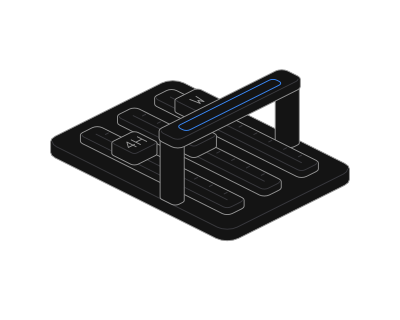
01 / CONTEXT
We read weekly, daily and four-hour price structure before considering an entry. Higher highs and higher lows describe a bullish structure; lower highs and lower lows describe a bearish one. Our structure engine uses completed candle bodies: a wick alone does not reverse the established trend.
We require alignment across consecutive timeframes — weekly and daily, or daily and four-hour. This creates a directional context for the AI assessment and helps distinguish a meaningful setup from a move against the prevailing structure.
Analysis is based on completed candles, with fresh lower-timeframe data verified before confirmation is evaluated.
A trade proposal must agree with the direction established by the required higher-timeframe structure.
02 / LOCATION
Our primary areas of interest come from weekly and daily price action. These are defined support or resistance regions with at least three meaningful, candle-verified touches, rather than arbitrary levels drawn around the current price.
An area must sit within the active structural bracket and have a bounded width. A daily area nested within a weekly area can add useful context. We establish the primary area for a session and keep it consistent during follow-up assessments.
03 / SETUP
Continuation setups look for a body-close break of an area, a retest in the higher-timeframe direction and a valid confirmation. We wait for the sequence to complete; the initial breakout alone is not an entry.
Reversal setups look for a completed head-and-shoulders or inverse head-and-shoulders pattern at a higher-timeframe area, followed by a neckline body-close break, retest and confirmation. We do not anticipate an unfinished right shoulder.
Confirmation uses lower-timeframe candles: bullish engulfing or morning star for a long proposal, bearish engulfing or evening star for a short proposal. The framework also includes ALEX-style refinements, such as optional 50 EMA confluence and structure-aware stop placement. AI can assess the supported methods within the same validation boundaries.
Area break → retest → directional confirmation.
Completed pattern → neckline break → retest → confirmation.
04 / RESEARCH
AI reviews relevant central-bank decisions, inflation and employment releases, other economic announcements and current news alongside the technical setup. Scheduled high-impact events can temporarily block new proposals within defined event windows.
Verified exceptional market events and data-integrity problems can also pause eligibility. General geopolitical background is treated as context rather than an automatic trading ban. Prediction-market information, when available and relevant, is supplementary sentiment context; it cannot independently create or size a trade.
05 / VALIDATION
AI produces a structured assessment with a direction, supporting evidence and a defined risk plan, or returns a watch condition or rejection. Independent code then checks session eligibility, trend alignment, the primary area, completed setup, confirmation, data freshness and risk requirements.
Each accepted plan has one entry, a protective stop beyond the confirmation wick and relevant structure, and one target selected from 1R, 2R or 4R. A target obstructed by nearby higher-timeframe structure is rejected. Position size and portfolio capacity are checked separately.
Explore risk & validation06 / REVIEW
We retain assessments, supporting context, validation results and simulated outcomes. This record lets us examine rejected proposals as well as accepted ones and investigate where the strategy behaves differently from its assumptions.
The base project configuration currently uses shadow simulation, with paper and live execution gates disabled. Simulation supports development and review; it is not evidence of live execution or a guarantee of future performance.
How decisions are recorded